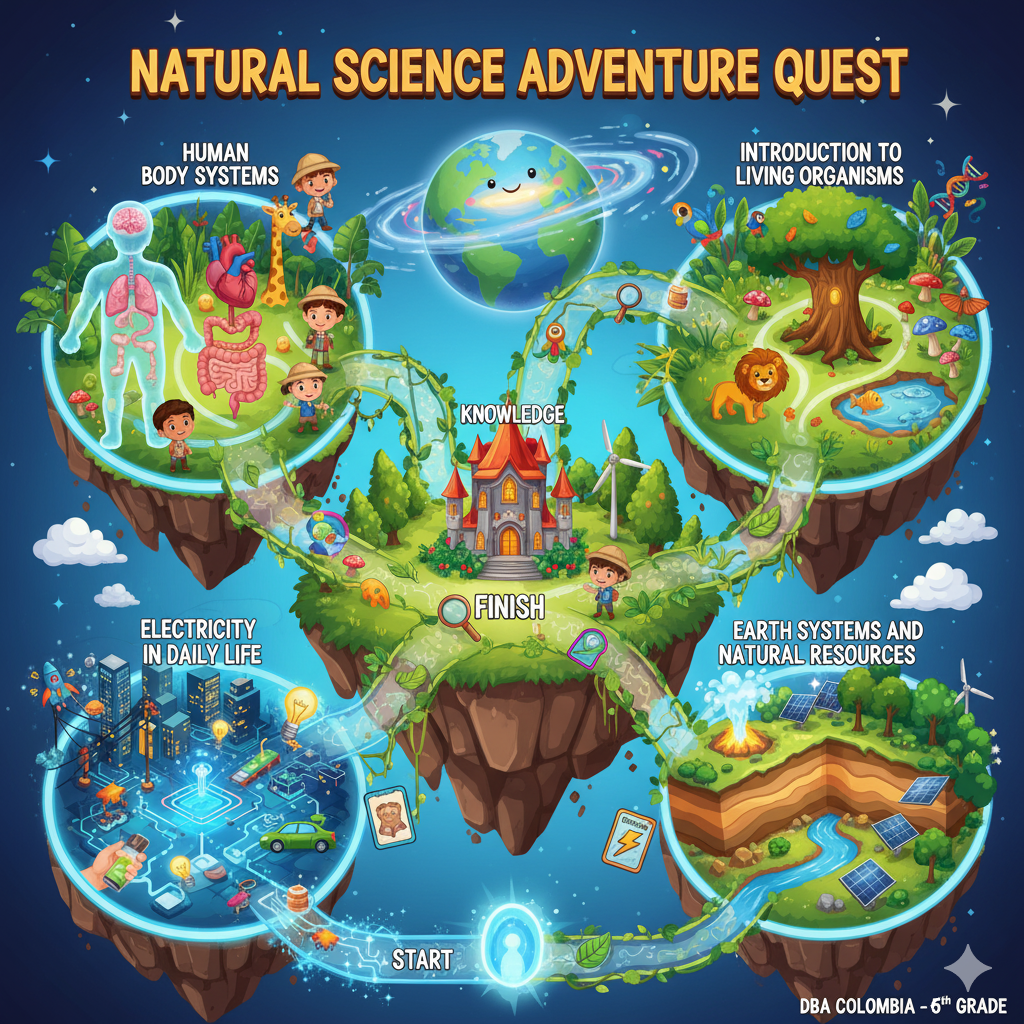

NATURAL SCIENCES | 9th Grade Preview 🔬
This course provides an intensive review of ninth-grade foundational science while looking forward to the complexity of high school physics, chemistry, and biology.
Key Focus Areas: Connecting the Micro to the Macro
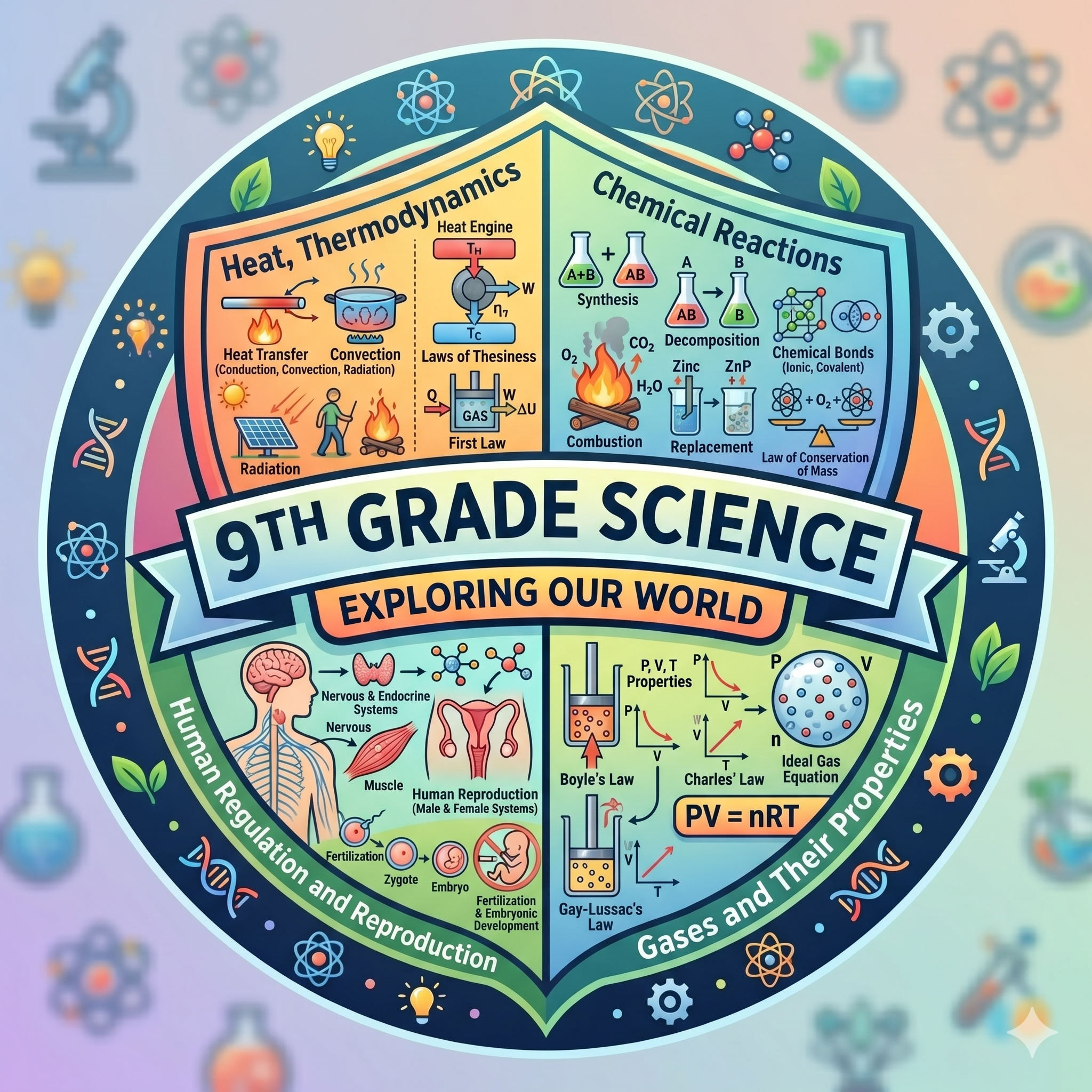
The curriculum bridges four core areas, moving from fundamental processes to global impact:
Chemical and Physical Reactions:
Thermodynamics & Energy: Understanding the concepts of heat, work, and energy transfer in systems, including the principles governing machines like combustion engines (First and Second Laws of Thermodynamics).
Chemical Change: Analyzing the behavior of matter, chemical reactions, and the factors (like electronegativity and valence electrons) that explain the formation and characteristics of compounds.
Gases: Studying the behavior of ideal gases and the relationships between pressure (P), volume (V), and temperature (T) using the Kinetic Molecular Theory.
Biological Systems (Homeostasis):
Organ Systems: Comprehending the interactions between different organ systems (nervous, endocrine, excretory, immune, etc.) to maintain homeostasis (internal balance).
Coordination: Analyzing the biological roles of hormones and neurons in regulating and coordinating body functions.
Reproduction: Exploring the biological mechanisms of reproduction and how factors like genetic variability and energy requirements impact the reproductive success and survival of species.
Earth and Environmental Science:
Ecology Review: Revisiting the interdependence of living organisms (biotic factors) and non-living components (abiotic factors) within ecosystems.
Geology: Applying scientific principles to understand large-scale Earth processes, such as volcanism and geological history.
This course emphasizes developing scientific inquiry skills—using evidence, modeling, and experimentation to explain phenomena across biology, chemistry, and physics.
This course provides an intensive review of ninth-grade foundational science while looking forward to the complexity of high school physics, chemistry, and biology.
Key Focus Areas: Connecting the Micro to the Macro
The curriculum bridges four core areas, moving from fundamental processes to global impact:
Chemical and Physical Reactions:
Thermodynamics & Energy: Understanding the concepts of heat, work, and energy transfer in systems, including the principles governing machines like combustion engines (First and Second Laws of Thermodynamics).
Chemical Change: Analyzing the behavior of matter, chemical reactions, and the factors (like electronegativity and valence electrons) that explain the formation and characteristics of compounds.
Gases: Studying the behavior of ideal gases and the relationships between pressure (P), volume (V), and temperature (T) using the Kinetic Molecular Theory.
Biological Systems (Homeostasis):
Organ Systems: Comprehending the interactions between different organ systems (nervous, endocrine, excretory, immune, etc.) to maintain homeostasis (internal balance).
Coordination: Analyzing the biological roles of hormones and neurons in regulating and coordinating body functions.
Reproduction: Exploring the biological mechanisms of reproduction and how factors like genetic variability and energy requirements impact the reproductive success and survival of species.
Earth and Environmental Science:
Ecology Review: Revisiting the interdependence of living organisms (biotic factors) and non-living components (abiotic factors) within ecosystems.
Geology: Applying scientific principles to understand large-scale Earth processes, such as volcanism and geological history.
This course emphasizes developing scientific inquiry skills—using evidence, modeling, and experimentation to explain phenomena across biology, chemistry, and physics.
- Teacher: Juan David Londoño Restrepo
- Teacher: Osmar Julián Martínez López